Chevrolet Colorado Mud Terrain Tires 4WD vs Ford F150 Pickup 2WD
Pickup trucks53 scenarios
Panel, equal weight
- claude-haiku-5.5anthropic/claude-haiku-5.5 @ claude-haiku-5.5 via OpenRouter
- deepseek-v4.1-flashdeepseek/deepseek-v4.1-flash @ deepseek-v4.1-flash via OpenRouter
- gemini-4-argongoogle/gemini-4-argon @ gemini-4-argon via OpenRouter
- gpt-6-lunaopenai/gpt-6-luna @ gpt-6-luna via OpenRouter
- mistral-large-4-0mistralai/mistral-large-4-0 @ mistral-large-4-0 via OpenRouter
AI consensus
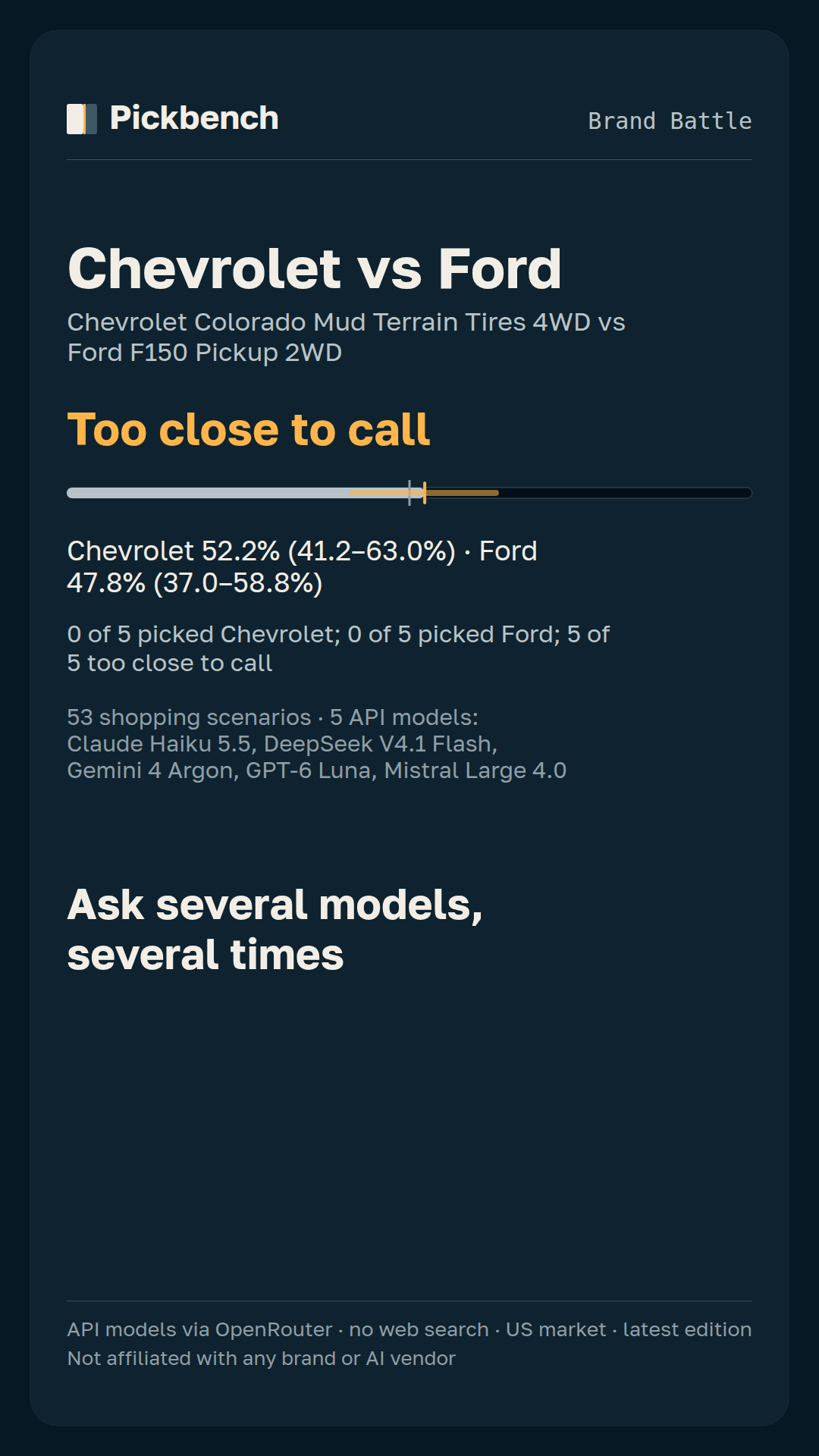
Fast panelToo closeThe panel’s interval includes 50%: taken together, these 5 API models do not pick between Chevrolet and Ford.
Chevrolet Colorado Mud Terrain Tires 4WD52%

Ford F150 Pickup 2WD48%

- Confidence interval for Chevrolet Colorado Mud Terrain Tires 4WD: 41–64%
Consensus95% interval 41–64%
Too close to call: the confidence interval includes 50%
Each model
Share for Chevrolet Colorado Mud Terrain Tires 4WDLeans to …
| Judge (API model) | Share for Chevrolet Colorado Mud Terrain Tires 4WD | Confidence interval | Leaning | Interval chart |
|---|---|---|---|---|
| claude-haiku-5.5 | 42% | 33–52% | Too close to call | |
| deepseek-v4.1-flash | 43% | 31–57% | Too close to call | |
| gemini-4-argon | 63% | 49–77% | Too close to call | |
| gpt-6-luna | 60% | 46–74% | Too close to call | |
| mistral-large-4-0 | 52% | 39–66% | Too close to call |
Replay it as a dropSimulated
Simulation: scenario paths made up to reproduce the published per-judge shares, not measured rows.
Too close to call: the confidence interval includes 50%
Published 95% confidence interval for Chevrolet: 41–64%. Press Drop to watch simulated scenarios land.
How to read it
Each ball is a simulated buying scenario. Each row of pins is an AI model, pushing the ball toward the brand it picked.
One drop is one sample. Drop again and the pile shifts; the orange band shows where the balance lands in 95% of drops.
A leader is named only when the band clears the middle. The paths are simulated from the published per-judge shares: no model saw these scenarios.
- Other needs
Tap to drop. Hold to keep dropping.
The numbers behind the machine
55c7f49daddcJSON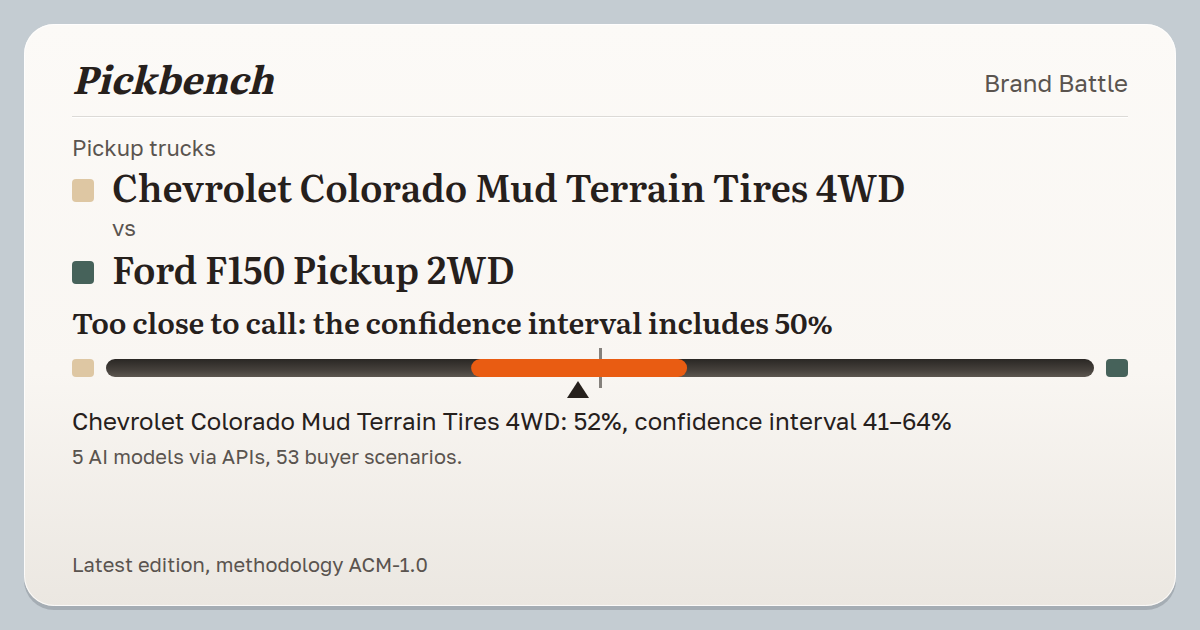
Embed
Free to embed. It shows the latest edition; keep the source line and the link.

How to read this
- Each scenario offers the models both brands; the split is how often each is chosen. The headline is the panel consensus with equal model weights.
- The band is the 95% interval for the left brand's share. A model leans to a brand only when its whole interval sits on one side of 50%.
- 95% confidence intervals (MOVER combination of the per-judge intervals, widened for small samples in battles and newer boards). The consensus gives equal weight to each model family. Per-judge results below are the primary measure.
- A single model's view is one judge, not the consensus.
- The drop machine is simulated: its paths reproduce the published per-model shares.
- Need cuts are withheld below 30 scenarios.
- Each page shows the latest edition. Dates are in the downloadable JSON.
- Fast panel: the fast or small current models of each vendor, not the full flagship panel.
Details and sources
Configurations compared: 2026 Chevrolet Colorado Mud Terrain Tires 4WD (Auto 8-spd, 4 cyl, 2.7 L, Turbo) vs 2026 Ford F150 Pickup 2WD (Auto (S10), 8 cyl, 5.0 L)
Results computed but not published Only the overall consensus and per-judge results are published for this battle: each buyer need has fewer than 30 scenarios, the pre-registered minimum for a need row. See who was counted and why
Who was counted
The rule that decides which judges count was fixed before the run. Judges that met it are counted with the weights below; the others are listed with their reasons.
- 53 buyer scenarios were planned.
- None of them was left out.
Consensus weights of 5 counted judges
| Judge (API model) | Model family | Weight in the consensus |
|---|---|---|
anthropic/claude-haiku-5.5 @ claude-haiku-5.5 via OpenRouter | anthropic | 20.0% |
deepseek/deepseek-v4.1-flash @ deepseek-v4.1-flash via OpenRouter | deepseek | 20.0% |
google/gemini-4-argon @ gemini-4-argon via OpenRouter | google | 20.0% |
openai/gpt-6-luna @ gpt-6-luna via OpenRouter | openai | 20.0% |
mistralai/mistral-large-4-0 @ mistral-large-4-0 via OpenRouter | mistral | 20.0% |
Judges not counted
Every judge on the panel met the rule.
Results computed but not published
Per-need scenario counts (n) are computed deterministically from the pre-registered plan.
- Buyer need: Daily commute
- n = 12 scenarios (fewer than 30) — Fewer scenarios than the pre-registered minimum
- Buyer need: Driving fun
- n = 6 scenarios (fewer than 30) — Fewer scenarios than the pre-registered minimum
- Buyer need: Family
- n = 10 scenarios (fewer than 30) — Fewer scenarios than the pre-registered minimum
- Buyer need: Reliability
- n = 15 scenarios (fewer than 30) — Fewer scenarios than the pre-registered minimum
- Buyer need: Low running costs
- n = 10 scenarios (fewer than 30) — Fewer scenarios than the pre-registered minimum
Methodology
Each judge is an AI model called through an API; “About this result” names each model and how it was called. In each buyer scenario, the judge chooses between the two brands. The scenario is the unit of analysis.
The results are based on 53 buyer scenarios.
A judge leans to a brand only when its confidence interval excludes 50%. Point estimates alone never count as a win.
Precision figures on this page are measured.
- Precision
- Measured
- Consensus, needs and languages
- 95% confidence intervals (MOVER combination of the per-judge intervals, widened for small samples in battles and newer boards)
- Per judge
- 95% confidence intervals (hull of the scenario-clustered bootstrap and Wilson intervals, widened for small samples in battles and newer boards)
- Scenario languages
- English
Data warnings
- Models chose on EPA specification facts only; purchase price, reliability and availability were not assessed.
About this result
What was measured, how, when, and how to check it.
- Methodology
ACM-1.0- AI models (API)
anthropic/claude-haiku-5.5 @ claude-haiku-5.5 via OpenRouter, via OpenRouter (pinned providers)deepseek/deepseek-v4.1-flash @ deepseek-v4.1-flash via OpenRouter, via OpenRouter (pinned providers)google/gemini-4-argon @ gemini-4-argon via OpenRouter, via OpenRouter (pinned providers)openai/gpt-6-luna @ gpt-6-luna via OpenRouter, via OpenRouter (pinned providers)mistralai/mistral-large-4-0 @ mistral-large-4-0 via OpenRouter, via OpenRouter (pinned providers)
- Conditions
- Each model was called through the route listed next to it and chose between the two brands in 53 buyer scenarios. Scenario languages: English.
- Judges counted
The pre-registered inclusion rule counted 5 of the 5 judges on the panel. The results use 53 of the 53 planned scenarios.
- Pre-registration (SHA-256)
268c3fd1b55dc9556a2b00145466f78e0c86ff2feca8c8bc24db81a281ce9431- What the pre-registration fixes
- Signed snapshot
Verify this result: download the signed snapshot (JSON)
- Signing key (kid)
FnG9tqyrr6Y0YUh6teXhpERjAKUSfzL78m4WdnEZ9Jg- Production key
- SHA-256 of the payload
55c7f49daddc90a644dea184605cca9d4999ff6227f8024f5fede2bb1c18ad6c
Rank, inclusion and influence on results are never sold.