TP-Link vs NETGEAR
Wi-Fi routers60 scenarios
Panel, equal weight
- Claude Haiku 5.5anthropic/claude-haiku-5.5
- DeepSeek V4.1 Flashdeepseek/deepseek-v4.1-flash
- Gemini 3.8 Flashgoogle/gemini-3.8-flash
- GLM-5.3 Flashz-ai/glm-5.3-flash
- GPT-6 Lunaopenai/gpt-6-luna
- Grok 4.7x-ai/grok-4.7
- Kimi K3.1 Promoonshotai/kimi-k3.1-pro
- Llama 4 Maverickmeta-llama/llama-4-maverick-17b-128e-instruct
- Mistral Small 2603mistralai/mistral-small-2603
- Qwen3.8 Flashqwen/qwen3.8-flash
The answer
ClearFast panel
TP-Link
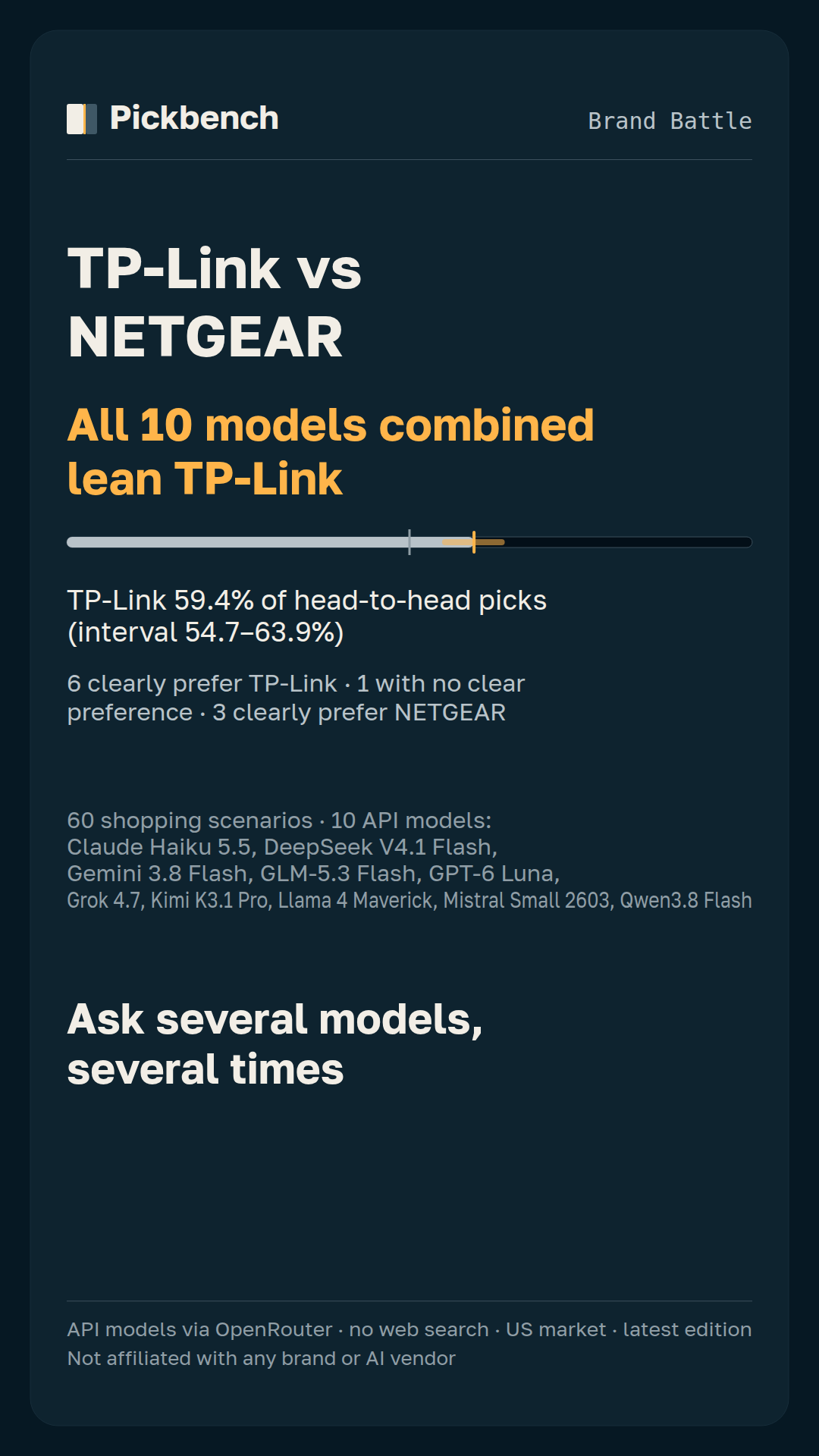
TP-Link 59% · NETGEAR 41% — all 10 models combined
6 clearly prefer TP-Link · 1 with no clear preference · 3 clearly prefer NETGEAR · all 10 models count in the overall result
95% interval for TP-Link: 54–64%
Detailseach model, intervals, conditions
All models combined
Fast panelClearAll 10 models combined lean TP-Link (the interval excludes 50%); on their own: 6 clearly prefer TP-Link · 1 with no clear preference · 3 clearly prefer NETGEAR.
TP-Link59%

NETGEAR41%

- Confidence interval for TP-Link: 54–64%
Consensus95% interval 54–64%
Each model
Share for the brand named in each row, with its interval
Bar: TP-Link from the left, NETGEAR from the right; dashed line = 50%.
| Judge (API model) | Brand and share | Confidence interval | Leaning | Interval chart |
|---|---|---|---|---|
| Claude Haiku 5.5 | NETGEAR: 61% | 52–70% | Clear preference | |
| DeepSeek V4.1 Flash | TP-Link: 83% | 75–90% | Clear preference | |
| Gemini 3.8 Flash | TP-Link: 80% | 69–89% | Clear preference | |
| GLM-5.3 Flash | TP-Link: 82% | 76–88% | Clear preference | |
| GPT-6 Luna | TP-Link: 75% | 68–81% | Clear preference | |
| Grok 4.7 | TP-Link: 49% | 38–60% | No clear preference | |
| Kimi K3.1 Pro | TP-Link: 71% | 62–80% | Clear preference | |
| Llama 4 Maverick | NETGEAR: 91% | 85–96% | Clear preference | |
| Mistral Small 2603 | NETGEAR: 70% | 61–79% | Clear preference | |
| Qwen3.8 Flash | TP-Link: 76% | 67–84% | Clear preference |
Replay it as a dropSimulated
Simulation: scenario paths made up to reproduce the published per-judge shares, not measured rows.
The AI consensus leans to TP-Link
Published 95% confidence interval for TP-Link: 54–64%. Press Drop to watch simulated scenarios land.
How to read it
Each ball is a simulated buying scenario. Each row of pins is an AI model, pushing the ball toward the brand it picked.
One drop is one sample. Drop again and the pile shifts; the orange band shows where the balance lands in 95% of drops.
A leader is named only when the band clears the middle. The paths are simulated from the published per-judge shares: no model saw these scenarios.
- Other needs
Tap to drop. Hold to keep dropping.
The numbers behind the machine
906effc65021JSON
Embed
Free to embed. It shows the latest edition; keep the source line and the link.

How this was measured · verify
How to read
The share is how often the models chose each brand, with its 95% interval. A brand leads only when its whole interval is above 50%, for all models combined and for each model on its own; otherwise it is too close to call.
Each page shows the latest edition. Dates are in the downloadable JSON.
Who was counted
- The pre-registered inclusion rule counted 10 of the 10 judges on the panel.
- The results use 60 of the 60 planned scenarios.
- Every judge on the panel met the rule.
Consensus weights of 10 counted judges
| Judge (API model) | Model family | Weight in the consensus |
|---|---|---|
| Claude Haiku 5.5 | Anthropic | 10.0% |
| DeepSeek V4.1 Flash | DeepSeek | 10.0% |
| Gemini 3.8 Flash | 10.0% | |
| GLM-5.3 Flash | Z.ai | 10.0% |
| GPT-6 Luna | OpenAI | 10.0% |
| Grok 4.7 | xAI | 10.0% |
| Kimi K3.1 Pro | Moonshot AI | 10.0% |
| Llama 4 Maverick | Meta | 10.0% |
| Mistral Small 2603 | Mistral AI | 10.0% |
| Qwen3.8 Flash | Qwen | 10.0% |
Need-level results
Need-level results are not published: 6 scenarios per need, below the pre-registered minimum of 30.
10 buyer needs
- Crowded apartment channels
- Cool running and living-room design
- Advanced settings for a home lab
- Stable smart-home devices
- Parental controls and bedtime schedules
- Fast fiber and streaming
- Low latency for gaming and video calls
- Whole-home coverage without dead zones
- Network security and guest Wi-Fi
- Simple app setup and remote fixes
Methodology
Each judge is an AI model called through an API; “About this result” names each model and how it was called. In each buyer scenario, the judge chooses between the two brands. The scenario is the unit of analysis.
- Version
ACM-1.0- Precision
- Measured
- Consensus, needs and languages
- 95% confidence intervals (MOVER combination of the per-judge intervals, widened for small samples in battles and newer boards). The consensus gives equal weight to each model family. The per-judge results in “Each model” are the primary measure.
- Per judge
- 95% confidence intervals (hull of the scenario-clustered bootstrap and Wilson intervals, widened for small samples in battles and newer boards). A single model's view is one judge, not the consensus.
- Panel
- Fast panel: the fast or small current models of each vendor, not the full flagship panel.
Data warnings
- Brand names only: the models saw each option as a brand name, with no product facts, and answered from their own knowledge.
About this result
- AI models (API)
- Claude Haiku 5.5
- DeepSeek V4.1 Flash
- Gemini 3.8 Flash
- GLM-5.3 Flash
- GPT-6 Luna
- Grok 4.7
- Kimi K3.1 Pro
- Llama 4 Maverick
- Mistral Small 2603
- Qwen3.8 Flash
Every model was called via OpenRouter (pinned providers).
- Conditions
- Each model chose between the two brands in 60 buyer scenarios. Scenario languages: English.
- Pre-registration (SHA-256)
89698c1a665c…What the pre-registration fixes- Signed snapshot
Verify this result: download the signed snapshot (JSON)
- Signing key (kid)
FnG9tqyrr6Y0…· Production key- SHA-256 of the payload
906effc65021…
Rank, inclusion and influence on results are never sold.